Marketplace or Your Own Website? 2025 E-Commerce Beginner's Guide


The first and most critical question on the minds of every entrepreneur who wants to open a store in the digital world is: Marketplace or your own website? This decision determines not only where you will sell, but also the future of your brand, your profitability, and your operational freedom.
Should you locate in a busy shopping mall (like Trendyol, Hepsiburada, Amazon) with high rents and strict regulations? Or should you own property on your own street (and run your own e-commerce site) and set your own rules?
Data from 2025, coupled with increasing competition and changing consumer habits, shows that the answer to this question is no longer "black or white." In this comprehensive guide, we will do the math together, considering current commission rates, hidden costs, marketing freedom, and customer loyalty.
1. Marketplaces: Ready-made Traffic, High Prices, and Strict Regulations
Trendyol, Hepsiburada, N11, or Amazon Turkey… These giant platforms offer you millions of people in "ready-made customer traffic." When you open a store and upload products, you can potentially reach all of Türkiye. However, the commercial cost of this convenience is not limited to commission alone.
Marketplace or your own website? For those caught in the dilemma, here are the realities and challenges of marketplaces in 2025:
High Commission and Service Fees
Kategorisine göre değişmekle birlikte, tekstilde %20-%25, elektronikte %5-%15 bandında seyreden kesintiler mevcuttur. Ancak giderler bununla bitmez:
- Marketing Contributions: If you don't allocate a budget for on-platform advertising, your visibility will decrease.
- Shipping Interruptions: Although platform-sponsored shipping rates may seem advantageous, in return processes, all costs (round trip) are generally passed on to the seller.
- Maturity Periods: The money from the product you sell doesn't go into your account immediately. Payment terms, which vary between 14 and 45 days depending on the marketplace, can strain your cash flow.
Buybox Wars and Price Pressure
In marketplaces, customer loyalty is focused on "price," not brand. To compete with dozens of sellers offering the same product, you'll constantly have to lower your prices. To gain "buybox" ownership (owning the "add to cart" button), you may need to minimize your profit margin. This threatens a sustainable business model.
Customer Data and Communication Restriction
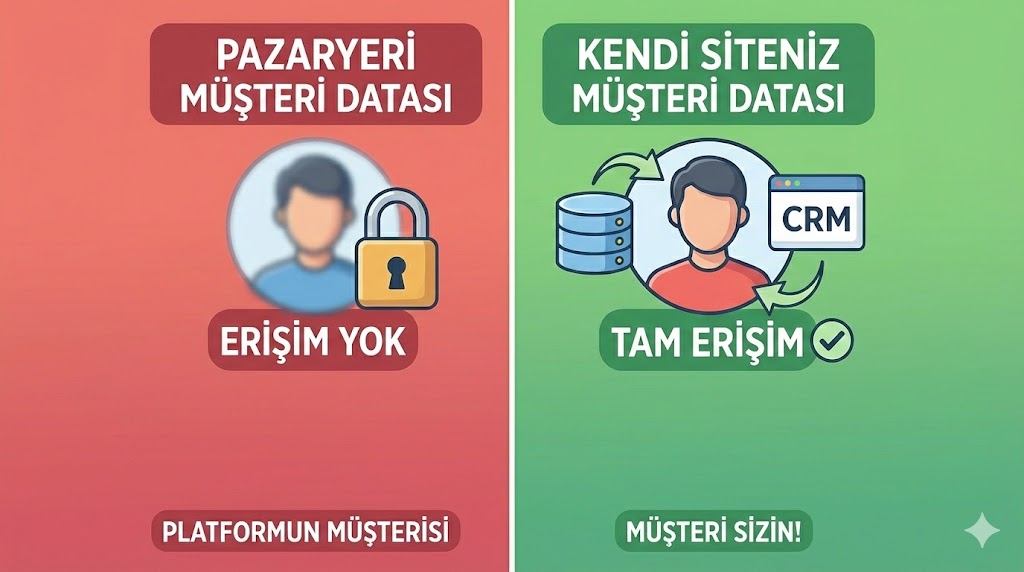
This is the biggest strategic disadvantage. Even though the customer buys the product from you, that person is essentially a "Trendyol customer".
- Putting your own business card or discount coupon in the shipping package may be considered a violation of the rules on some platforms.
- You cannot send marketing messages to customers via phone or email due to GDPR regulations.
- This means you would have to pay commission to the marketplace again to sell a second product to the same customer.

Expert Note: Marketplaces are like your brand's "showcase." They're great for cash flow and inventory reduction, but building brand value is on shaky ground.
2. Your Own E-Commerce Website: Freedom and Data Power
Building your own e-commerce website (using Shopify, iKAS, Ticimax, WooCommerce, etc.) is about building the future, not just saving the day. While attracting traffic initially requires effort and an advertising budget, you have complete control.
Marketplace or your own website? Those who answer the question with "My own website" will have a strategic advantage in 2025:
Profitability and Zero Commission
Kendi sitenizde, satış başına pazaryerine ödediğiniz o %20’lik dilim cebinizde kalır. Sadece ödeme altyapısı sağlayıcılarına (Iyzico, Stripe, PayTR vb.) çok düşük oranlarda (%1,5 – %3) komisyon ödersiniz. Bu marj farkı, reklam bütçenizi finanse etmenizi sağlar.
Data-Driven Marketing (Data is King)
In 2025 and beyond, the most valuable asset will be "customer data." On your own website:
- Pixel and Conversion APIs: You can track your visitors using Google and Meta (Facebook/Instagram) pixels and show them targeted ads to those who leave items in their cart (retargeting).
- Email and SMS Marketing: Having your customers' data allows you to announce your new season products or promotions to them for free.
- Lifetime Value (LTV): Even if you don't make a profit on your first sale to a customer, you can still generate profit by selling to them repeatedly throughout the year thanks to your data. This isn't possible on a marketplace.
Brand Identity and Customer Experience (UX)
Your website's design, colors, "About Us" page, and blog posts create an "emotion" in the customer. Unlike standard templates on marketplaces, you can stand out from the price competition by offering a "premium" experience to the customer on your own site.
3. Comparison Table: What Do the Numbers Say?
Bride, setting up an e-commerce website Let's simulate selling in the marketplace with a product worth 1000 TL (using estimated figures):
| Expense Item | Marketplace Scenario | Your Own Website Script |
| Product Selling Price | 1,000 TL | 1,000 TL |
| Komisyon (%20 vs %2.5) | -200 TL | -25 TL (Virtual POS) |
| Shipping Costs | -50 TL | -50 TL |
| Advertising / Marketing | -50 TL (Within Platform) | -200 TL (Google/Social Media)* |
| Service/Infrastructure Fee | -10 TL | -20 TL (License etc.) |
| THE NET AMOUNT YOU RECEIVE | 690 TL | 705 TL (+ Customer Data) |
*Note: While your website's advertising budget varies, the advertising cost for a second sale is close to zero thanks to the customer data you collect.
Although the numbers in the table seem close, what you earn in the "Your Own Website" scenario... Customer Data, It is invaluable in the long run.
4. Infrastructure Selection: Which Software is Right for You?
Marketplace or your own website? When you decide to launch your own website, you'll encounter powerful infrastructure options. Here's what we, Ehelp.com.tr, have experienced with the brands we've provided consulting services to:
Shopify: A Global Player
If you're thinking globally and want to enhance your site with thousands of plugins (apps), this is a world-leading option. You can create amazing designs using drag-and-drop without needing any coding knowledge. However, you should consider the monthly payments based on foreign currency.
Ikas: Fast and Local
A rising star for Turkey-focused SMEs seeking speed and practicality. Thanks to its next-generation JS infrastructure, it achieves high scores on Google PageSpeed, providing an SEO advantage. It has very strong shipping and invoicing integrations for the Turkish market.
Ticimax / Ideasoft: Fundamental Solutions
They offer "all-inclusive" packages, especially for companies with complex inventory structures that require multi-marketplace integration. Having local support teams is an advantage.
5. Marketing Freedom: Google Ads and SEO
Your own website's greatest strength SEO (Search Engine Optimization) It is the ability to do.

- Blog Content: You can attract organic (free) traffic from Google by writing blog posts related to your industry (like the one you're reading now). Your marketplace store usually appears in Google search results based on product, not content.
- Google Shopping Ads: You can visually showcase the products on your own website in the Google Shopping tab, ahead of your competitors.
6. Frequently Asked Questions (FAQ)
To help clear up any questions you may have, we've compiled a list of the most frequently asked questions:
Question: I have no technical knowledge, can I manage my own website? Answer: Yes. Ready-made platforms like Shopify or iKas have user-friendly dashboards that don't require technical knowledge. Anyone who can use Word or Excel can manage these dashboards.
Question: If I create my own website, should I shut down the marketplaces? Answer: Absolutely not. The best strategy is to run both simultaneously. Marketplaces should be your "promotional channels," and your own website should be your "main hub.".
Question: How long does it take to drive traffic to my website? Answer: With a proper advertising strategy (Google & Meta Ads), you can attract traffic from day one. However, establishing SEO (organic) traffic may take 3-6 months with regular content creation.

Conclusion: The winning strategy is the "Hybrid Model".“
A successful e-commerce operation in 2025 won't require putting all your eggs in one basket. A marketplace alone will make you dependent on the platform; a website alone might lead to slow growth initially.
The most accurate strategy Hybrid Modeldir:
- Marketplaces Use it as a "hunting ground" to acquire new customers, clear inventory, and build brand awareness.
- Your own website Make it your "fortress" to increase profitability, create a loyal customer base, conduct data-driven marketing, and institutionalize your brand.
A small box to put inside the boxes along with the product. “Bir sonraki alışverişinizde sitemize özel %10 indirim” Even coupons are the simplest way to attract marketplace customers to your own site and make commission-free sales.
Professional Support for Your E-Commerce Journey
Don't let technical details, integration issues, or digital marketing strategies intimidate you.
Ehelp.com.tr We determine the e-commerce strategy that best suits your brand's DNA; we install Shopify, iKas, or Ticimax platforms on a turnkey basis. We don't just install; we also handle post-installation support. SEO And Performance Marketing We are with you throughout the process.
To chart your brand's 2025 growth roadmap with professionals. Our E-Commerce Consulting Service You can browse our page or contact us immediately.