
E-commerce Guide for Beginners

E-commerce has become one of the most accessible and scalable business models for entrepreneurs in recent years. It's possible to reach large audiences at low costs without needing a physical store. However, e-commerce is as complex as it is attractive. "How to start e-commerce?" is the first question anyone wanting to enter this world asks.
In this guide, even if you have no technical or business knowledge, We will explain step-by-step how you can start an e-commerce business from scratch. We will cover the entire process in detail, from company formation and product selection to opening an e-commerce website and digital marketing.
What is e-commerce and who is it suitable for?
E-commerce is the sale of goods or services over the internet. These sales can be made through your own e-commerce website or through marketplaces such as Trendyol, Hepsiburada, and N11.
Who is e-commerce suitable for?
- Those who want to start their own business
- Those who want to earn extra income
- Those who want to move their physical store to digital
- For those who want to sell without inventory (dropshipping)
- Entrepreneurs who want to create their own brand
The biggest advantage of e-commerce is, independence of time and space It offers a certain advantage. However, this doesn't mean "easy money." E-commerce ventures can fail without proper planning.
Essential Knowledge for Beginners in E-commerce

Before starting an e-commerce business, you need to clarify some fundamental issues.
❗ Set realistic expectations.
E-commerce typically doesn't generate high profits in the initial months. Brand awareness, SEO, and advertising performance improve over time.
❗ Patience and sustainability are essential.
Successful e-commerce sites typically begin to see significant results after 6–12 months.
❗ Be open to learning
Continuous learning is necessary in marketing, advertising, customer experience, and analytics.
Define your business model.
The most crucial answer to the question of how to start e-commerce: the right business model.
The most common e-commerce business models
🔹 Stock-based E-commerce
You purchase the products in advance, store them, and ship them.
Advantage: The profit margin is high.
Disadvantage: There are inventory costs and risks.
🔹 Dropshipping (E-commerce without inventory)
As orders come in, the supplier ships the product to the customer.
Advantage: Low capital
Disadvantage: Supply and cargo control is weak.
🔹 Marketplace Sales
Sales are made through platforms such as Trendyol, Hepsiburada, and Amazon.
Advantage: Ready customer traffic
Disadvantage: Commission rates are high.
🔹 Selling Your Own Brand (Private Label)
You reach an agreement with the manufacturer and sell the products under your own brand.
Advantage: You create brand value.
Disadvantage: The initial cost is high.
Product Selection: The Foundation of Success
Choosing the wrong products is the most common reason for failure in e-commerce.
Things to consider when choosing a product
- Is there demand?
- What is the level of competition?
- Is the profit margin sufficient?
- Is the shipping cost low?
- Is the return rate high?
Recommended Products for E-commerce Beginners
- Small and lightweight products
- Products that are not at risk of breakage.
- Trendy but not temporary products
- Products with repeat purchase potential
Company Formation and Legal Procedures
To do e-commerce in Türkiye It is mandatory to establish a company..
The most common types of companies
🏢 Sole Proprietorship
- Low cost
- Quick setup
- Ideal for beginners.
🏢 Limited Company
- Corporate structure
- High perception of trust
- Higher cost
Generally for beginners sole proprietorship recommended.
E-commerce Website Setup
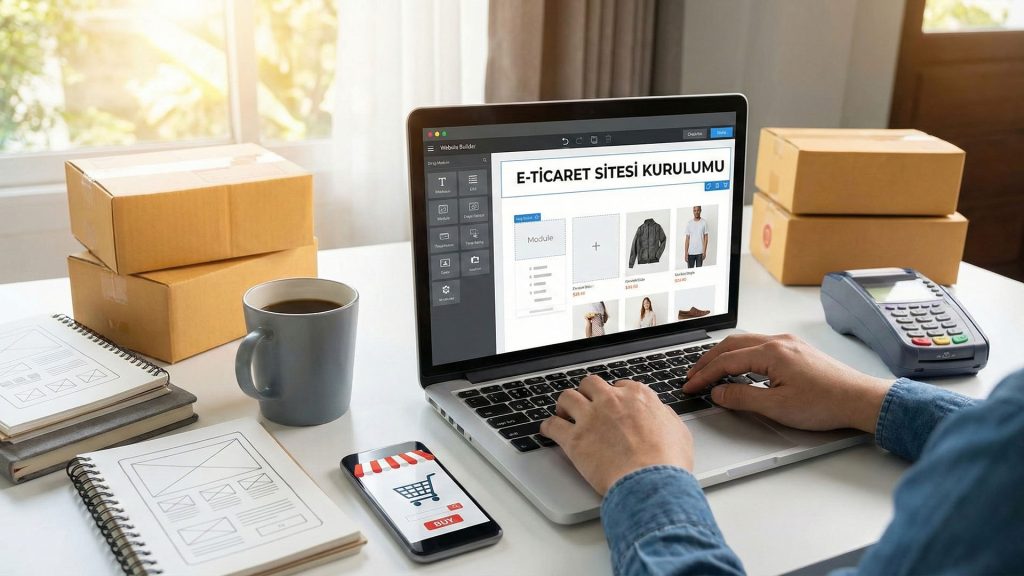
“The most concrete step in answering the question "How to start e-commerce?" is to create an e-commerce website.
E-commerce infrastructure options
- Ready-made e-commerce packages
- Custom software
- Open source systems (WooCommerce, etc.)
For beginners ready-made e-commerce infrastructures, It provides speed and cost advantages.
Essentials for an e-commerce website
- Mobile-friendly design
- Fast loading time
- Secure payment infrastructure
- User-friendly interface
- SEO-friendly structure
Payment Systems and Security
The issue that customers pay the most attention to: trust.
Payment methods that should be used
- Credit card
- Bank Transfer / EFT
- Cash on delivery (optional)
Essentials for security
- SSL certificate
- Secure payment providers
- Transparent return and privacy policies
Cargo and Logistics Process
Fast and trouble-free shipping is key to customer satisfaction.
Things to consider during the shipping process
- Contracted shipping companies
- Net delivery times
- Damage and return management
- Sharing the tracking number
Product Page and Content Optimization
In e-commerce, sales take place on the product page.
What makes a good product page?
- Clear and descriptive title
- SEO-friendly product description
- High-quality product images
- Net price and campaign information.
- Customer reviews

Digital MarketingHow to Increase Sales
Setting up an e-commerce website isn't enough. You need to attract traffic.
Main digital marketing channels
🔹 SEO (Search Engine Optimization)
It provides long-term and sustainable traffic.
🔹 Google Ads
It is effective for quick sales.
🔹 Social Media Advertising
It is ideal for brand awareness and sales.
🔹 Email Marketing
It's the best way to retain existing customers.
Customer Service and Returns Management
A happy customer = repeat sale.
For effective customer support
- Quick turnaround
- Clear communication
- Easy return process.
- Automated support systems
Performance Tracking and Analysis
In e-commerce, you can't improve anything you can't measure.
Metrics to track
- Number of visitors
- Conversion rate
- Basket abandonment rate
- Advertising ROI
- Average basket value
The Biggest Mistakes Beginners Make
- Unplanned product selection
- Expecting sales without advertising.
- Ignoring customer experience
- Acting impatiently
- Not seeking professional help
The Importance of Seeking Professional Support
E-commerce is a multidisciplinary field. Managing the technical infrastructure, marketing, SEO, and operational processes alone can be challenging.
at this point e-commerce consulting, This speeds up the process and prevents costly errors.
Conclusion: How to Start an E-Commerce Business?
In summary, to start an e-commerce business:
- Define your business model.
- Choose the right product.
- Establish your company.
- Launch a professional e-commerce website.
- Actively utilize digital marketing channels.
- Continuously analyze and improve.
E-commerce requires the right strategy and patience. a sustainable income model It can transform.
When embarking on your e-commerce journey, you need to manage many aspects correctly simultaneously, from technical infrastructure and product management to digital marketing and performance analysis. Getting professional support during this process will save you time and prevent costly mistakes. Ehelp, By offering end-to-end consulting and operational support to businesses ranging from new e-commerce startups to scaling brands, we help businesses take solid steps forward in the digital world. With the right strategy, the right tools, and the right business partners, it is possible to make the e-commerce process faster and more sustainable.